



The sacred temple complex of Palitana Temples holds immense spiritual significance for the Jain community. Located on Shatrunjaya Hill in Gujarat, it is one of the most revered pilgrimage sites in Jainism. Hundreds of temples rise together like a sacred city in marble, creating an awe-inspiring landscape that feels almost otherworldly.
For many Jain households, having an image or painting of Palitana in their home is believed to bring positivity, devotion, and a spiritual connection to the sacred site.
Recently, I had the opportunity to create a large commissioned painting of Palitana — a project that was both deeply exciting and unexpectedly challenging.
Returning to a Painting After Three Years
Interestingly, this was not the first time I had painted Palitana. This commission was actually a recreation of a previous painting I had created about three years ago.

Whenever an artist recreates their own work, it brings a very unique kind of pressure.
On one hand, there is the expectation to match the beauty of the earlier piece. On the other hand, there is a strong inner push to create something even better — something that reflects the growth that has happened over the years.
The earlier painting was beautiful in its own way, but in the years since then my artistic skills and understanding of composition have evolved. I knew this new version had to carry that evolution.
Designing the Journey of the Eye
One of the biggest differences in this painting was my focus on composition and visual movement.
Instead of simply depicting the temples, I wanted the viewer to experience the landscape.
The stairs winding through the greenery were intentionally designed to guide the viewer’s eye into the painting. As the gaze follows the staircase, it travels through the layers of temples, architecture, and landscape.
The goal was to create a sense that the viewer is walking through the sacred complex, slowly discovering each structure.
When someone pauses in front of this painting, I hope they don’t just see it — I hope they travel through it.
Colour, Atmosphere, and Mood
Another major decision was the atmosphere of the painting.
I chose to depict the temples during a serene sunset, where warm golden light washes over the architecture. The temples glow in hues of burnt sienna, warm oranges and golden yellows
These colours create a sacred warmth that enhances the spiritual feeling of the scene.
To balance the warmth of the temples, I introduced lush green foliage and dense bushes, giving the landscape a subtle forest-like depth. The greenery frames the temples and helps them emerge dramatically from the hillside.
The Challenge of Scale and Detail
This painting was created on a 3 ft by 4 ft canvas, making it one of the largest canvases I have worked on so far.
Ironically, while the canvas was the largest I’ve painted on, I used some of the smallest brushes I own.


The temples of Palitana are known for their intricate architecture, and capturing that required extremely fine detailing. Many of the structures — the stairways, domes, and temple carvings — were painted with tiny, careful strokes.
There were days when I would simply sit in front of the canvas and stare at it, wondering what the next step should be. Large paintings often demand patience, observation, and quiet moments of decision-making.
Studying the Real Palitana
To design the composition, I studied several reference photographs of the temple complex from different angles. I examined at least five to six perspectives in order to understand the spatial relationship between the temples.
However, the painting is not meant to be a strict architectural replication.
For example, I introduced elements such as the open sky blending with water in the distance. While the real landscape is different, I made these choices intentionally to create a more harmonious and aesthetically pleasing composition.
Art often allows us to balance reality with imagination.
From Trial and Error to Intentional Process
When I think back to the first time I painted Palitana, I clearly remember how uncertain and experimental the process felt.
That earlier painting involved a lot of trial and error. I would paint something, step back, realize it wasn’t working, and then paint over it again. Many areas were redone multiple times as I tried to figure out what worked best.
In many ways, I was thinking directly on the canvas.
This time, the process felt very different.
Over the past few years, after consistent practice and training, I have developed a clearer structure for building a painting. Before even touching the canvas, I now approach the work with a planned sequence.
First comes the design and composition, followed by the initial sketch.
After that, I carefully mark the shadows to establish depth and structure.
Then I block the midtones and highlights, creating the overall form of the painting.
Only once that structure is complete do I begin adding the fine details.


Because of this approach, there were far fewer mistakes and almost no need to repaint large areas.
That doesn’t mean the process was easier — it simply meant the thinking happened earlier.
In the previous painting, I remember thinking while painting.
In this one, I often found myself pausing and thinking before placing the brush on the canvas.
That subtle difference reflects how much my artistic process has evolved.
A Sacred Presence in the Home
For many followers of Jainism, Palitana represents devotion, discipline, and the pursuit of spiritual purity.
Because of this, many Jain homes keep an image or painting of Palitana as a symbol of faith and positivity.
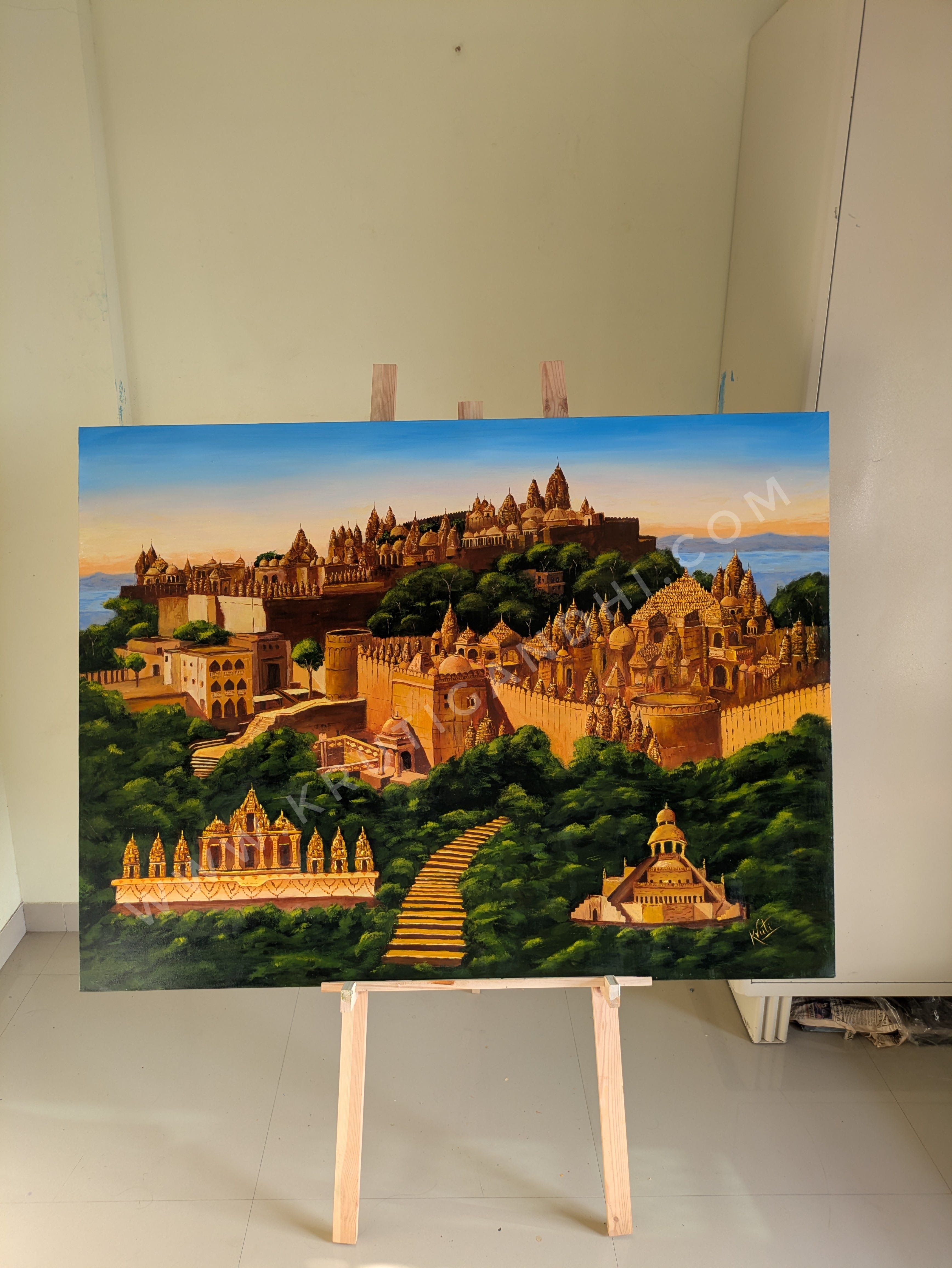
Knowing that this painting will live in someone’s home — not only as a work of art but also as something spiritually meaningful — made this commission especially special to create.
A Journey in Paint
Looking back, this painting became more than just a commission.
It was a reflection of my growth as an artist — of patience, observation, and the evolution of my creative process.
From designing the composition to painting the tiniest architectural details, every step reminded me that painting is not just about the final image. It is about the journey of creating it.
And if someone standing in front of this painting pauses for a moment and feels like they are walking through the temples of Palitana Temples, then I know the painting has truly done its job.
Creating meaningful artworks like this is one of the reasons I love working on commissioned pieces. When a painting represents a place that holds spiritual or personal significance, it becomes much more than just an artwork — it becomes something people live with and connect to every day.


If you would like to commission a painting of a sacred place, temple, or landscape that is meaningful to you, feel free to reach out through my website. I would love to create something special for your space.
Happy Creating